SUPPLEMENTARY DOCUMENT
SCRIPT
Summary
On a bus ride back to Toronto, former child stars and best friends, Emily Orchid and Daniela Crest, must inhabit roles from their pasts to solve a murder. Can they solve the case before the bus brings the killer back to Toronto? “Bus Stop” investigates the decisions that get made for children, the relationship between artists and fans, and the distance we go for our friends.
Reviews for Bus Stop:
- Toronto Star: “a fun and original scenario”, “whimsy overflows … as Ho packs a full length play’s worth of plot twists into an hour-long show”, “Ho’s staging cleverly embraces the levels of the Passe Muraille Mainspace”
- Broadway World: “Ho’s gentle, jokey humour… outsized quirk”, “interesting”, “energetic … cast members”
- Intermission Magazine: “Hilarious, clever, and touching”, “Ho’s writing is masterful, funny, and sentimental”, “absolute delight… instantly brightens your day so powerfully”
background
Bus Stop was my third full-length play, and my second attempt at producing a show for the Toronto Fringe. Bus Stop was my directorial debut. I first started writing Bus Stop in 2021, but did not finish until the winter of 2023.
We began production in Feb 2024, and the show ran 7 times in Theatre Passe Muraille’s Mainspace Theatre during the Fringe, July 3-15th 2024.
I co-produced this show with Davide Sallese, under our production company, a little body productions. Our team also included assistant director Cas Duarte, stage manager Riley Stefan, and assistant stage manager Jo Tamaru.
The full cast/crew can be found at this link below:
INSPIRATION
Noir and mysteries are two genre I have always loved, but had yet to try writing. Some of my inspirations for the script as well as the production included movies & TV of the genre: Knives Out, Brick, Murder on the Orient Express, Haunting in Venice, Logan Lucky, Brothers Bloom, Maltese Falcon, Thoroughbreds. I also found inspiration in Godzilla Minus One, as well as children’s media like Alfred Hedgehog.
Themes & DESIGN
Some themes I focused on for this production were the responsibilities we place on children, surveillance, and how fiction can affect reality. I wanted the audience to be constantly aware they were watching a show, and to question the qualia of the show.
I began with constructing the experience of seeing a show before the lights even went down in the house. I asked my graphic designer, Jocelyn Zin, to design a program that would nod to classic bus tickets/maps, as another way to remind the audience of the temporal aspect of travelling, and of seeing a show (below).


To build onto this feeling, I instructed my actors to play the improvisational drama game, bus stop, as the house opened. Audience members could filter in and were invited to decide to watch what was happening on stage, and to question if what was happening was ‘part of the show’.
SET


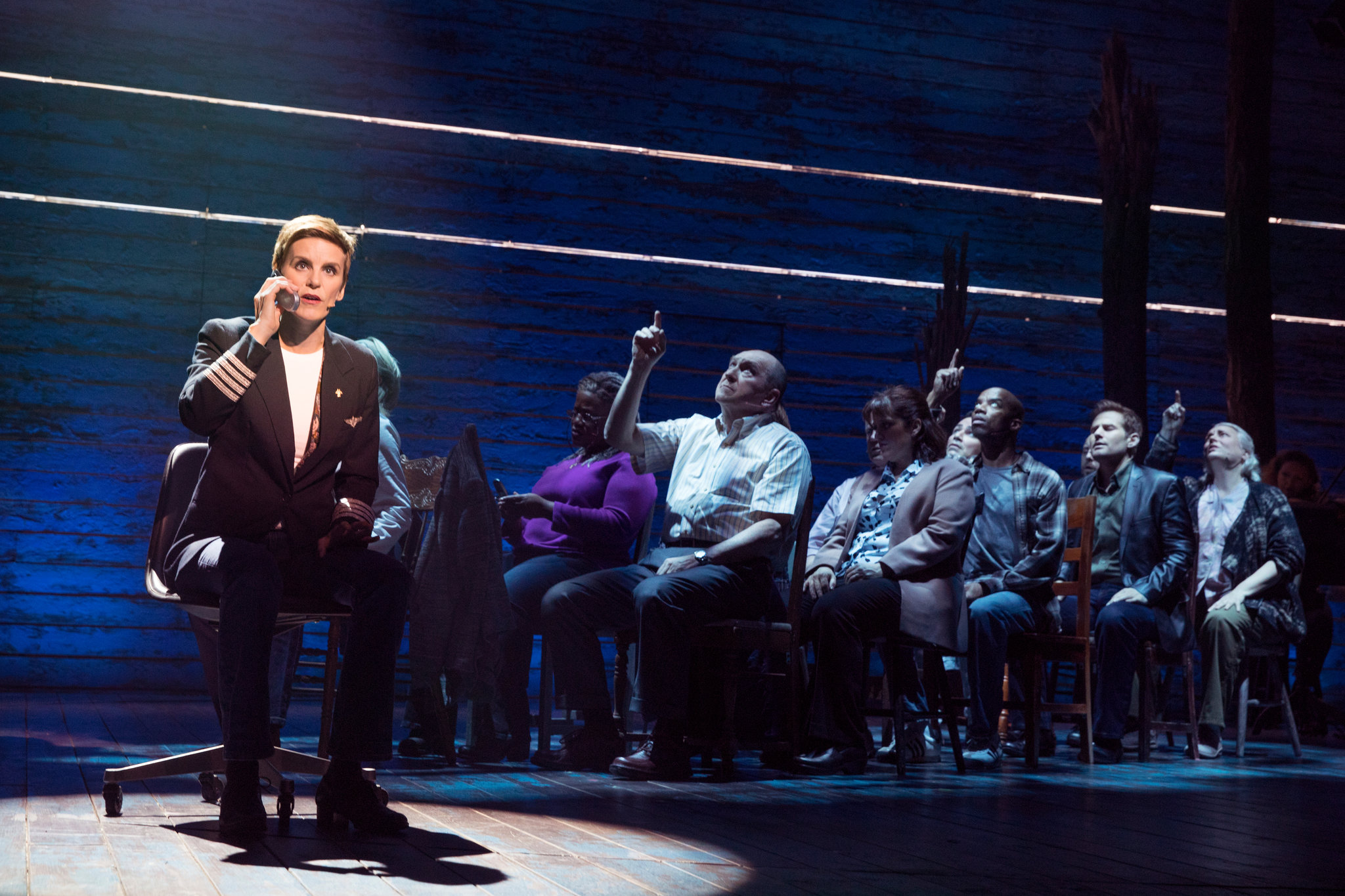
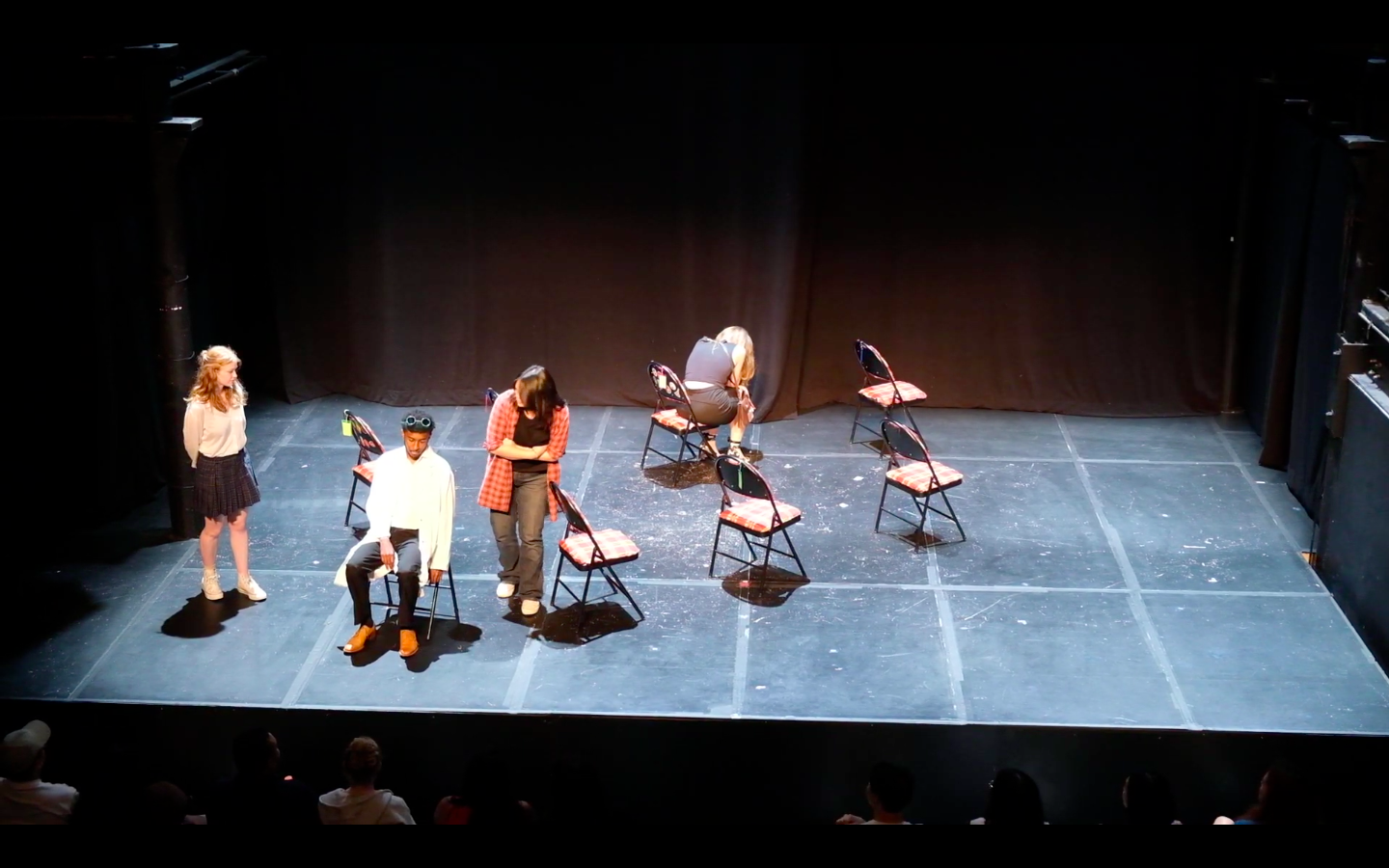
Bus Stop, in the true working limitations of a Fringe Festival, had a minimal set design. Partially inspired by Come from Away (below, left), I utilized 8 folding chairs, each re-upholstered with a fabric to look like the seats on a cross-country bus.
Above is a scene map I made to demonstrate to the cast where each chair should be placed during scenes; each cast member was responsible for moving the chairs between transitions.
effects/tech
The result is a puppet built to look like the actor playing Dr Ziff Bermann, the victim, with detachable limbs; a somewhat gorey ‘delimbing’ sound; and a moody, dark look that served to lower visibility and sell the effect.


 HELEN HO INDUSTRIES